Wednesday, 16 August 2017

Tuesday, 15 August 2017
Monday, 24 July 2017
Top 10 Questions for AWS
Top 10 Questions for AWS
AWS pricing is efficient ?
Amazon took a dynamic approach to pricing its hosting when launching AWS. Every service is like pay only when you use. This makes a lot of sense for server infrastructure, as traffic tends to be very bursty, especially the larger the site is.Traditional hardware, for the most part, goes unutilized for 90% of its lifecycle. AWS helps deal with this problem by keeping it cheap during the slow times.
Most Used Components of AWS ?
The key components of AWS are
Simple Storage Device or (S3): It is a storage device and the most widely used AWS
service
Elastic Compute Cloud (EC2): It provides on-demand computing resources for hosting
applications. It is very useful in case of unpredictable workloads
Elastic Block Store (EBS): It provides persistent storage volumes that attach to EC2 to
allow you to persist data past the lifespan of a single EC2
CloudWatch: To monitor AWS resources, It allows administrators to view and collect
key Also, one can set a notification alarm in case of trouble.
Route 53: A DNS web service
Simple E-mail Service: It allows sending e-mail using RESTFUL API call or via regular
SMTP
Identity and Access Management: It provides enhanced security and identity
management for your AWS account
AMI and Instance Usage?
From a single AMI, you can launch multiple types of instances. An instance type defines the
hardware of the host computer used for your instance. Each instance type provides different
compute and memory capabilities. Once you launch an instance, it looks like a traditional host,
and we can interact with it as we would with any computer.
Sending requests to S3 ?
Amazon S3 is a REST service, you can send request by using the REST API or the AWS SDK
wrapper libraries that wrap the underlying Amazon S3 REST API.
Vertical Scalability an Amazon instance? How?
Yes, you can vertically scale on Amazon instance. For that
Spin up a new larger instance than the one you are currently running
Pause that instance and detach the root webs volume from the server and discard
Then stop your live instance and detach its root volume
Note the unique device ID and attach that root volume to your new server
And start it again
Why AWS pricing is efficient ?
Amazon took a refreshing approach to pricing its hosting when launching AWS. Every service is "a la carte", meaning you pay for what you use. This makes a lot of sense for server infrastructure, as traffic tends to be very bursty, especially the larger the site is.
Traditional hardware, for the most part, goes unutilized for 90% of its lifecycle. AWS helps deal with this problem by keeping it cheap during the slow times.
Top User of AWS :
- Adobe Systems
- Airbnb
- Alcatel-Lucent
- Aon
- Autodesk
Databses , Datawarehouse , Analytics in AWS :
DynamoDB : NoSQL
Redshift : Datawarehouse
Data Pipeline : ETL
EMR : ProcessData
QuickSight : Analytics
Artificial Intelligence IN AWS
Lex
Polly
Rekognition
Machine Learning
Internet Of Things IN AWS :
AWS IoT
AWS Greengrass
Saturday, 17 October 2015
The Benefits of Earning A PMP Certification
Is Earning Your PMP® Certification Worth the Costs?
A full version of this post was originally published on SoftwareAdvice.com.
In the project management field, the question of whether or not to earn your Project Management Professional (PMP) Certification is often in the air. Many would argue the Project Management Institutes (PMI) PMP certification is an important step forward and a wise career move while others might say that while it is certainly a well-respected credential, it is not for everyone.
Enterprise Resource Planning Analyst, Derek Singleton recently asked several Project Management and hiring experts to give their opinions on who should get a PMP certification, what it takes to get one, and the potential payoff. Below is some of what they said.
Real-World Experience is Necessary for a PMP Certification
The most basic thing to understand about the PMP certification is that individuals seeking it must already have a strong base and interest in project management and certainty that they want to pursue it as a career.
In addition, you must have professional experience managing projects. The amount of experience necessary is dependent on your education path to PMP certification. All experience must be had no more than eight years before submitting your application. Education requirements for project management certification can usually be met within three to four months through PMP courses. Criteria for what types of tasks, knowledge, and skills this experience must align with are further outlined here.
After passing these requirements you must pass a 200 question exam which costs $500. Once you pass this exam, you will become a PMP certified project manager. The question for many individuals is whether the amount of work it takes to become certified is worth it. According to the experts, it is.
PMP Certification Shines on a Resume
As with any type of well-respected certification, a PMP certification adds credit to your resume and makes you far more competitive. Kevin Archbold, a Consulting Manager at Key Consulting explains that many recruiters divide resumes into two different piles based on those with and those without certification. This means even those who have proven past success in project managing can greatly benefit from PMP certification.
Competition within the project management discipline is high and employers can afford to be selective. PMP certification in any industry is almost always helpful and in many industries it is even necessary.
PMP Certification Yields Higher Salaries
The average salaries of project managers with certification are significantly higher than those without certification. A 2011 survey of 30,000 project management professionals indicated an average salary of $111,824 per year for those who had received PMP certification compared to an average yearly salary of $97,829 for those who were not certified.
PMP Certification Enables Stronger Communication
Many of the PMP experts revealed that PMP certification greatly helped them in their ability to articulate important aspect of a project charter such as project goals, needed resources, assumptions, and risks. It provides you with a common language that allows you to better communicate with clients and vendors and cuts out confusion, need for explanation, and difficulty conveying a point.
It is of course possible to learn these skills without formal training. However, formal training provides standardization, a common set of definitions, and a set of best practices that can be difficult to successfully grasp otherwise. Having a strong understanding of these concepts are critical for successfully managing and completing any project.
PMP Certification Allows You to Plan Ahead for High Project Manager Demand.
The Anderson Economic Group is predicting that 1.2 million project management positions will need to be filled yearly until 2016. The job market is particularly strong in the IT industry where 40 percent of IT executives state that they have plans to hire a PMP in the next year. With this being said, planning ahead for this demand and putting yourself in a strong position for the future by obtaining certification is wise.
If you do not already have the project management experience required to obtain certification, experts recommend starting with a training course. Maggie Donovan, a Program Manager at Dell Storage Marketing worked in the financial department at Apple. After completing a PMP training course, she landed in her current job and her salary instantly doubled. Donovan says of starting with a training course, “You’ll be so much more effective at your job and understand why things get done in a certain way if you start with formal training. After gaining enough experience, then you can go for certification.
Are you interested in the benefits of PMP® Certification?
For Details
and to be in Contact:
Website: www.professional-guru.com
Sunday, 12 April 2015
Data Profiling with Informatica Data Quality
One of the first steps in solving a data quality problem is to perform data profiling. As seen in Jason Hover’s article, Data Profiling: What, Why and How?, data profiling allows you to analyze your data to determine what it looks like and what problems exist in the data. Manual data profiling can be performed; however, using software such as Informatica Data Quality allows both data stewards and developers to collaboratively profile the data in a common repository more quickly, often yielding a more thorough analysis.
Informatica Data Quality offers profiling capabilities within both the Informatica Analyst and Informatica Developer tools. Within Analyst, data stewards can quickly create a profile of the data:

Data Profiling With Informatica Data Quality Image (A.1)
As seen in image (A.1), a data steward can see that there are 4 records with a NULL value in column ADDR2. The data steward can also see that the values are mixed case. Here, the data steward may determine that NULL values are not valid and that the values should be standardized to uppercase. The values of San Diego, SD, SAN DIEGO should also all be SAN DIEGO. The data steward can add this as a comment for the developer to create a rule (A.2).

Data Profiling With Informatica Data Quality Image (A.2)
In the Developer tool, the same profile can be viewed with the comments provided by the data steward (A.3).

Data Profiling With Informatica Data Quality Image (A.3)
The developer can now apply profile rules to the ADDR2 column based on the business rules provided. Applying profiling rules allows the data steward to identify possible inconsistencies in the data and potentially correct the data in the source system. Note: The output of the profile rule is a virtual column in the profile; the rule has not been applied to the data physically until a mapping has been created in Developer.
Informatica Data Quality provides a number of pre-built rules, which can be applied directly to the profile within either the Analyst or Developer tool. In this example, we will use the pre-built rules of rule_Completeness and rule_UpperCase and create a new rule to standardize the values for SAN DIEGO.
Before creating the rule to standardize values for SAN DIEGO, we need to create a list of valid values. In Informatica Data Quality, the list of valid values can be created as a reference table. The reference table will be used as a lookup to determine what value should be returned. TIP: A quick way to create a reference table with valid values is to add the values from the data that has been profiled. Right click on the value and select Add to Reference Table. (A.4).

Data Profiling With Informatica Data Quality Image (A.4)
Once the table is created, the list of valid values can be added (A.5). The ADDR2 column serves as the valid value. If the value in column1, column2, or column3 exists, it will return the valid value found in column ADDR2. The reference table can then be maintained through the Analyst tool by the data steward (where an audit trail is captured).

Data Profiling With Informatica Data Quality Image (A.5)
TIP: If the data steward does not want to edit the table to include additional columns, the same valid value in column ADDR2 can be added and the additional values can be listed in column1, column2, column3 as highlighted in Image (A.6).

Data Profiling With Informatica Data Quality Image (A.6)
Now we can create a rule in the Developer tool to use the reference table. After applying the rule in the profile, we can see that there are now 3 records with the value of SAN DIEGO (A.7).

Data Profiling With Informatica Data Quality Image (A.7)
Although we are using 3 different profile rules, we can take it one step further and combine the rules into one profile rule. The rules are seen as mapplets in Developer. In this example, we will create one mapplet named rule_ADDR2 that will include 3 mapplets (one for each rule previously identified) (A.8).

Data Profiling With Informatica Data Quality Image (A.8)
Taking the output from rule_Completeness, we will determine if the record is valid (A.9).

Data Profiling With Informatica Data Quality Image (A.9)
TIP: Make sure to validate the mapplet as a Rule so that it will appear in the Analyst tool (A.10).

Data Profiling with Informatica Data Quality Chart (A.10)
After this rule is applied in the profile and re-run, the data steward can see how many records are valid or invalid. The data steward can then drilldown on the invalid records.

Data Profiling with Informatica Data Quality Chart (A.11)
As seen in Image (A.11), there are 4 invalid records because they are NULL. The data steward can then export this data, perform further analysis, update the source system, update the reference table, and/or work with the developer to update the rule. Once profiling of the data is complete and all rules have been identified/updated, then the rules can be physically applied to the data and cleansed.
This data profiling example illustrates one of many techniques that can be used within Informatica Data Quality. Collaboration amongst the data steward and developer during the data profiling process are key in taking the first steps in solving a data quality problem.
Tuesday, 20 January 2015
ORACLE WEB LOGIC FEATURES
Oracle Cloud Application Foundation andNew/Changed feature in WebLogic 12.1.2 (New Installer, BSU replaced byopatch, dynamic cluster etc). In this post I am going to cover Dynamic Cluster in WebLogic Server 12.1.2
If you are new to WebLogic Server then I highly recommend you to read my previous post on WebLogic Domain, Admin & Managed Server
- Dynamic Cluster is a new feature introduced in WebLogic 12.1.2 which makes creating and managing WebLogic Cluster really simple and quick.
- In a normal WebLogic Cluster (aka Configured Cluster) you defineManaged Server and add them to Cluster.
- In Dynamic Cluster , you select number of Servers you want in Cluster and Server Template you wish to assign to Servers in this WebLogic Dynamic Cluster.
- Servers (or Managed Server) that are part of WebLogic Dynamic Cluster will have properties taken from Server Template
- If you need to modify any setting for Dynamic Servers (part of Dynamic Cluster), you modify Server Template that is applicable to Dynamic Cluster.
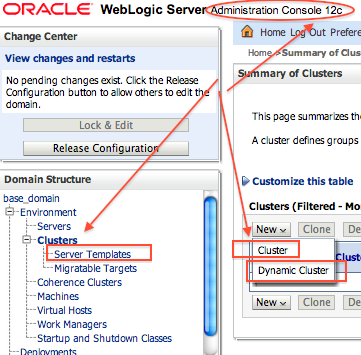
How to create a Dynamic Cluster in WebLogic 12.1.2
1. Login to WebLogic Console : Environment -> Clusters : New -> Dynamic Cluster : Enter name of dynamic cluster and click Next
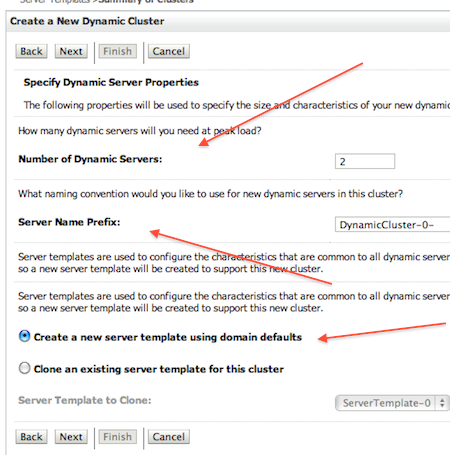
2. On “Specify Dynamic Server Properties” page specify Number of Servers that you wish to create in cluster , Server Prefix Name and Server Template (You canCreate new Server Template or Clone an existing Server Template )
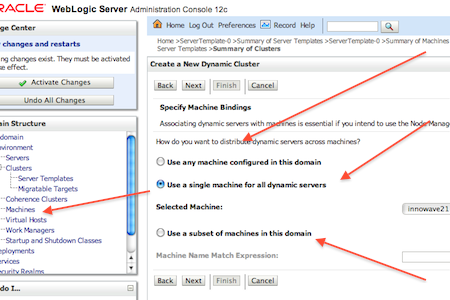
3. In “Specify Machine Bindings” specify Host where you wish to start Servers in this cluster
You can start Servers part of this cluster on
a) Any Machine that are part of this domain
b) All Servers on same Machine
c) Start Servers on sub set of Machines
b) All Servers on same Machine
c) Start Servers on sub set of Machines
Note: Machine must be configured in WebLogic Domain
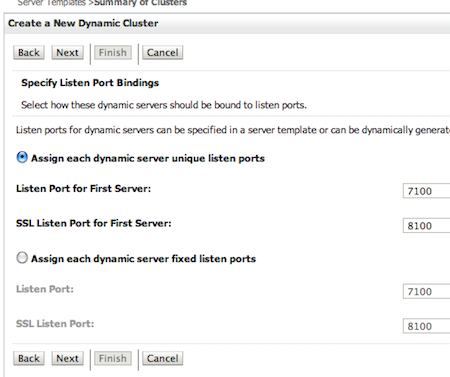
4. On Specify Listen Port Binding page , specify on what port these Servers (part of Dynamic Cluster) should listen
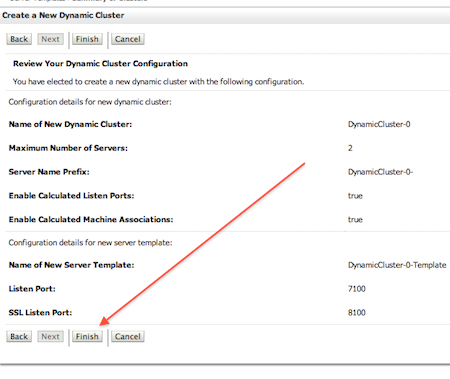
5. On Review Your Dynamic Cluster Configuration page , review cluster configuration page and click Finish
6. If WebLogic Domain is configured in production mode (other is development mode) then Activate Change
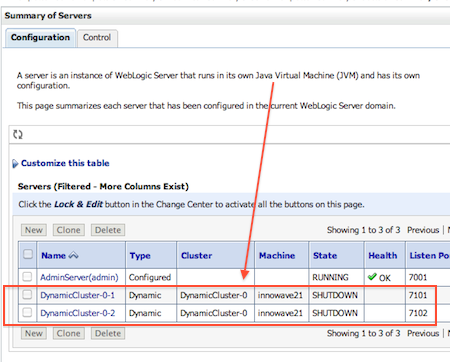
7. Finally Verify Server Details
Monday, 19 January 2015
Why you should learn Java Programming Language
Why Java is best Programming language - why learn JavaHere is my list of 10 reason, which I tell anyone who ask my opinion about learning Java, and whether Java is best programming language in terms of opportunities, development and community support.
1) Java is Easy to learn
Many would be surprised to see this one of the top reason of learning Java, or considering it as best programming language, but it is. If you have steep learning curve, it would be difficult to get productive in short span of time, which is the case with most of professional project. Java has fluent English like syntax with minimum magic characters e.g. Generics angle brackets, which makes it easy to read Java program and learn quickly. Once a programmer is familiar with initial hurdles with installing JDK and setting up PATH and understand How Classpath works, it's pretty easy to write program in Java.
2) Java is an Object Oriented Programming Language
Another reason, which made Java popular is that it's an Object Oriented Programming language. Developing OOPS application is much easier, and it also helps to keep system modular, flexible and extensible. Once you have knowledge of key OOPS concept like Abstraction, Encapsulation, Polymorphism and Inheritance, you can use all those with Java. Java itself embodies many best practices and design pattern in it's library. Java is one of the few close to 100% OOPS programming language. Java also promotes use of SOLID and Object oriented design principles in form of open source projects like Spring, which make sure your object dependency is managed well by using dependency Injection principle.
3) Java has Rich API
One more reason of Java programming language's huge success is it's Rich API and most importantly it's highly visible, because come with Java installation. When I first started Java programming, I used to code Applets and those days Applets provides great animation capability, which amazes new programmer like us, who are used to code in Turbo C++ editor. Java provides API for I/O, networking, utilities, xml parsing, database connection, and almost everything. Whatever left is covered by open source libraries like Apache Commons, Google Guava and others.
4) Powerful development tools e.g. Eclipse , Netbeans
Believe it or not, Eclipse and Netbeans has played huge role to make Java one of the best programming language. Coding in IDE is pleasure, especially if you have coded in DOS Editor or Notepad. They not only helps in code completion but also provides powerful debugging capability, which is essential for real world development. Integrated Development Environment (IDE) made Java development much easier, faster and fluent. It's easy to search, refactor and read code using IDEs. Apart from IDE, Java platform also has several other tools e.g.. Maven and ANT for building Java applications, decompilers, JConsole, Visual VM for monitoring Heap usage etc.
5) Great collection of Open Source libraries
Open source libraries ensures that Java should be used everywhere. Apache, Google, and other organization has contributed lot of great libraries, which makes Java development easy, faster and cost effective. There are framework like Spring, Struts, Maven, which ensures that Java development follows best practices of software craftsmanship, promotes use of design patterns and assisted Java developers to get there job done. I always recommend to search for a functionality in Google, before writing your own code. There is good chance that, it's already coded, tested and available for ready to use.
6) Wonderful community support
Community is the biggest strength of Java programming language and platform. No matter, How good a language is, it wouldn't survive, if there is no community to support, help and share there knowledge. Java has been very lucky, it has lots of active forums, Stackoverflow, open source organizations and several Java user group to help everything. There is community to help beginners, advanced and even expert Java programmers. Java actually promotes taking and giving back to community habit. Lots of programmers, who use open source, contribute as commiter, tester etc. Expert programmer provides advice FREE at various Java forums and stackoverflow. This is simply amazing and gives lot of confidence to a newbie in Java.
7) Java is FREE
People like FREE things, Don't you? So if a programmer want to learn a programming language, or a organization wants to use a technology, COST is an important factor. Since Java is free from start, i.e. you don't need to pay anything to create Java application. This FREE thing also helped Java to become popular among individual programmers, and among large organizations. Availability of Java programmers is another big think, which makes organization to choose Java for there strategic development.
8) Excellent documentation support - Javadocs
When I first saw Javadoc, I was amazed. It's great piece of documentation, which tells lot of things about Java API. I think without Javadoc documentation, Java wouldn't be as popular, and it's one of the main reason, Why I think Java is best programming language. Not every one has time and intention to look at code to learn what a method do or how to use a class. Javadoc made learning easy, and provide an excellent reference while coding in Java. With advent of IDE, you don't even need to look Javadoc explicitly in browser, but you can get all information in your IDE window itself.
9) Java is Platform Independent
In 1990s, this was the main reason of Java's popularity. Idea of platform independence is great, and Java's tag line "write once run anywhere" was enticing enough to attract lots of new development in Java. This is still one of the reason of Java being best programming language, most of Java applications are developed in Windows environment and run in UNIX platform.
10) Java is Everywhere
Yes, Java is everywhere, it's on desktop, it's on mobile, it's on card, almost everywhere and so is Java programmers. I think Java programmer out number any other programming language professional. Though I don't have any data to back this up, but it's based on experience. This huge availability of Java programmers, is another reason, why organization prefer to choose Java for new development than any other programming language.
Having said that, programming is very big field and if you look at C and UNIX, which is still surviving and even stronger enough to live another 20 years, Java also falls in same league. Though there are lot of talk about functional programming, Scala and other JVM languages, but they need to go a long way to match community, resources and popularity of Java. Also OOPS is one of the best programming paradigm, and as long as it will be there Java will remain solid.
Subscribe to:
Comments (Atom)